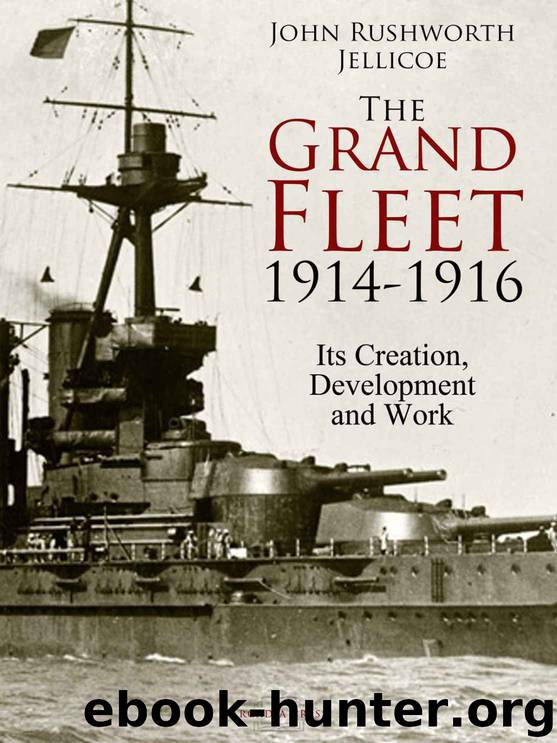
The Grand Fleet, 1914-1916: Its Creation, Development and Work by John Rushworth Jellicoe
Author:John Rushworth Jellicoe
Language: eng
Format: azw3
Published: 2017-06-24T04:00:00+00:00
CHAPTER IX: CONTROLLING THE NOETH SEA
DURING the later months of 1915 the Grand Fleet continued to sweep and control the North Sea in spite of the enemy’s efforts to effect attrition by submarines and mines. On October 1st the 3rd Light Cruiser Squadron, with destroyers escorting, left Rosyth and proceeded towards the Little Fisher Bank; on reaching that locality the squadron turned to the north-westward and steered towards Scapa, arriving on the 3rd. The line thus swept was the possible course of enemy mine-laying or other vessels, proceeding towards, or returning from, the vicinity of Scapa and Cromarty. No enemy ships were sighted.
On October 2nd the battleship Barham, Flagship of the new 5th Battle Squadron, arrived at Scapa.
Commodore Tyrwhitt, with the 5th Light Cruiser Squadron (now comprising six light cruisers) and nine destroyers, left Harwich on the 6th to sweep towards the Skagerrak in search of enemy vessels, particularly fishing trawlers, which were suspected of acting as outpost vessels. The operation on this occasion was fruitful in result; 14 German trawlers were captured and sent in; one was also sunk. As usual during such operations when a supporting force was not actually at sea, the Battle Cruiser Fleet was kept at short notice for steam, to be ready to put to sea if required.
On October 10th the 3rd Light Cruiser Squadron left Scapa and swept down to the Little Fisher Bank, and thence to Rosyth with the same object in view as that of the Harwich force, being met at daylight on the 11th by destroyers from Rosyth, and arriving at that base on the 12th. On this occasion the operation gave no result.
The Dreadnought Battle Fleet, comprising the 1st, 2nd and 4th Battle Squadrons, the 1st, 2nd and 7th Cruiser Squadrons, the 4th Light Cruiser Squadron, and the 2nd and 4th Flotillas, left Scapa on the 13th, and proceeded into the northern portion of the North Sea for a cruise. Owing to bad weather the destroyers were sent back on the 11th, one, the Mandate, being damaged by a heavy sea; the Ardent and Fortune collided, the former vessel being damaged. The fleet carried out battle exercises during the cruise, and returned to the bases at Scapa and Cromarty on the 15th, on which day the new battleship Canada joined the Grand Fleet.
On October 18th the Harwich force, consisting of the 5th Light Cruiser Squadron and destroyers, sailed to operate off the Danish coast, north of the Horn Reef, against any enemy vessels found there. The Lion, with the 1st Battle Cruiser Squadron and eight destroyers, left Rosyth to support the Harwich force, which closed the Danish coast at daylight on the 19th, then steered to the north-westward, till dark, returning afterwards to Harwich. The search was unproductive, no enemy vessels being sighted. The Lion and 1st Battle Cruiser Squadron proceeded towards Cromarty, but were diverted to Scapa during the night of the 19th-20th, owing to a report of suspicious vessels, possibly mine-layers, being sighted off Noss Head. These vessels were subsequently identified as two of our own trawlers.
Download
This site does not store any files on its server. We only index and link to content provided by other sites. Please contact the content providers to delete copyright contents if any and email us, we'll remove relevant links or contents immediately.
| Africa | Americas |
| Arctic & Antarctica | Asia |
| Australia & Oceania | Europe |
| Middle East | Russia |
| United States | World |
| Ancient Civilizations | Military |
| Historical Study & Educational Resources |
The Radium Girls by Kate Moore(12035)
100 Deadly Skills by Clint Emerson(4931)
Rise and Kill First by Ronen Bergman(4797)
The Templars by Dan Jones(4695)
The Doomsday Machine by Daniel Ellsberg(4493)
The Rape of Nanking by Iris Chang(4222)
Killing England by Bill O'Reilly(4008)
Stalin by Stephen Kotkin(3973)
Hitler in Los Angeles by Steven J. Ross(3949)
12 Strong by Doug Stanton(3554)
Hitler's Monsters by Eric Kurlander(3347)
Blood and Sand by Alex Von Tunzelmann(3207)
The Code Book by Simon Singh(3197)
Darkest Hour by Anthony McCarten(3135)
The Art of War Visualized by Jessica Hagy(3014)
Hitler's Flying Saucers: A Guide to German Flying Discs of the Second World War by Stevens Henry(2758)
Babylon's Ark by Lawrence Anthony(2685)
The Second World Wars by Victor Davis Hanson(2529)
Tobruk by Peter Fitzsimons(2521)
